
Honestly? You’re not the only one who has been experiencing traffic wackiness lately.
In the last couple months, I have heard from a few business owners, a small law firm, a local plumber, and a marketing consultant, and nearly all of them have asked me the same question: Why did my rankings just plummet?
It’s Google, in a nutshell. The longer answer is a little bit more complex, but bear with me.
Something Shifted and It’s Bigger Than a Typical Update
Google makes changes all the time. The vast majority of them don’t make the cut. However, recent developments have not been the typical background noise. The company has actually thrown out a lot of the fundamentals of content evaluation and many sites are feeling the pinch of taking shortcuts for years that they were unaware of.
What is new is that the core idea is not new, but it is being enforced more rigorously. Google wants content created for people, not for the search engine. Simple enough in theory. The problem is, for years the SEO world operated on a different playbook stuff keywords in, build links, churn out articles. That playbook is getting retired, fast.
Right now, websites that got popular by using weak content, cookie-cutter pages, or just churning out a lot of articles are really feeling the crunch. But then you have sites that really know their stuff, have a clear viewpoint, and publish content that genuinely helps people find answers some of those are quietly having their most successful year ever when it comes to getting visitors from search engines.
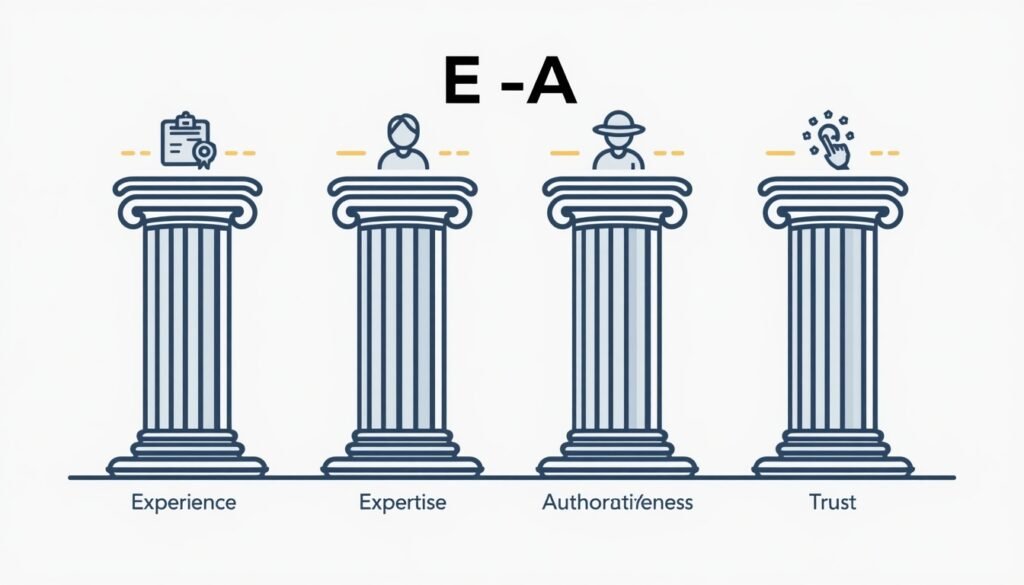
You might have heard of E-E-A-T. It’s a really important concept that stands for Experience, Expertise, Authoritativeness, and Trustworthiness. Google has been discussing this idea for some time now, but it feels like it’s become much more important lately.
Here’s why it matters in practice. Say you run a law firm and you’ve got a blog. If those posts don’t have a named attorney as the author someone with actual credentials and a real professional history Google is increasingly less likely to surface that content in competitive search results. It’s not that you get penalized exactly. It’s more like the sites that *do* show clear expertise get a meaningful edge over the ones that don’t.
Same goes for digital marketing, medical information, financial advice any space where bad information could genuinely hurt someone. Google holds those areas to a higher standard, and rightly so.
The fix isn’t complicated, but it does require some effort: real author bios, credentials people can verify, and content that reflects actual experience rather than just summarizing what’s already out there.
Technical SEO Didn’t Die. But It Took a Back Seat.
There was a stretch maybe 2020 through 2022 where it felt like SEO had become almost entirely a technical discipline. Core Web Vitals, page speed scores, structured data, schema markup. Developers were suddenly the most important people in any SEO conversation.
That stuff still matters. Don’t let anyone tell you it doesn’t. A website that loads in six seconds on mobile is going to struggle no matter how good the content is.
But the balance has shifted. Technical performance gets you to the starting line. What happens after that is determined by whether your content is genuinely worth reading.
The team at RankDMS has been writing about this shift in a pretty grounded way worth a look if you want to see how it’s playing out across different industries and business types.
What’s the Real Story With AI Content?
This is where things get a little messy, and I think a lot of people are overthinking it in both directions.
Google hasn’t banned AI-written content. What it has done is get much better at identifying content that’s hollow pages that look like they’re answering a question but don’t actually say anything useful. That description fits a lot of AI-generated content, but it also fits plenty of human-written content that was written on autopilot.
The actual question Google is asking isn’t about authorship. It’s asking whether the content demonstrates real knowledge and actually helps whoever lands on it.
So if you’re using AI tools to speed up research, draft outlines, or knock out a first pass and then you’re actually editing it, adding your own perspective, and making sure it reflects real expertise you’re probably fine. If you’re clicking “generate article” and uploading whatever comes out, the recent updates are working against you whether you realize it yet or not.
Local Search Is a Whole Other Story
For a lot of businesses law firms, clinics, service companies local search is where the real action is. And Google’s been making significant changes there too.
It’s not just about collecting five-star reviews anymore. The quality of those reviews matters. How you respond matters Google pays attention to whether businesses engage with their reviews or just ignore them. Your Google Business Profile needs to be complete, accurate, and consistent with everything on your actual website.
That last part trips people up more than you’d expect. If your website says your office hours are 9 to 5 and your Google profile says 9 to 6, that’s a small discrepancy that Google notices. Multiply that across dozens of small inconsistencies and it starts adding up.
So What Do You Actually Do Now?
A few things are worth prioritizing, in roughly this order.
First, go through your existing content and be honest about it. Which pages exist to rank for a keyword versus which pages actually help someone? The ones that fall in the first category — update them or consolidate them into something stronger.
Second, put real names and real credentials behind your content. Author pages, bios, links to professional profiles. Make it verifiable.
Third, don’t try to fix everything at once. Pick the 10 or 15 pages that matter most to your business and make those excellent before touching anything else.
And fourth sort out the technical stuff if you haven’t already. Not because it’ll save you from bad content, but because good content deserves a site that doesn’t drive people away before they’ve had a chance to read it.
If you own a business and just don’t have the time to keep up with all of this yourself, it makes a lot of sense to work with people who specialize in it. Digital marketing folks who stay on top of all the algorithm changes can actually save you from making costly decisions based on old information.
The Honest Takeaway
Google doesn’t make random changes, and they’re not trying to hurt good websites. What they’re really after is a certain kind of SEO that always focused on tricking the system instead of actually helping readers.
If your site has always tried to be genuinely useful even if imperfectly you’re in a better position than you might think. And if it hasn’t, well. There’s no better time to change that than right now, before the next update makes it even harder.
5 Questions People Actually Ask About This
1. My website uses AI-written content. Should I be worried?
Depends on what kind. If it’s thin, generic content that doesn’t add anything beyond what’s already out there yes, you should probably revisit it. If it’s been edited by someone with real subject matter knowledge and it reads like it was written for an actual human reader, you’re likely in a much better spot. The issue was never really AI vs. human. It was always useful vs. useless.
2. How can I tell if a Google update actually hurt my site?
You can open up Google Search Console and check your performance data from the last six months. What you’re looking for is a sudden, noticeable drop in impressions or clicks that didn’t bounce back. Then, compare that date to Google’s official update announcements. If they match up, you’ve likely found the reason. Tools like Ahrefs and Semrush can give you even more specific info for individual pages if you want to investigate further.
3. Is recovery even possible after one of these updates?
Well, it is possible, but it definitely won’t happen overnight. Usually, Google re-evaluates sites affected by a core update when the next one comes around, which tends to be every few months. Still, if you make real improvements to your content quality, show better E-E-A-T (experience, expertise, authoritativeness, and trustworthiness), and fix your site’s technical issues, you might see some recovery sooner than that. There’s really no quick fix for it.4. Honestly, is SEO still worth it with all these changes?
4. is SEO still worth it with all these changes?4
More than ever, I’d argue. The businesses that get hurt by algorithm changes are typically the ones that were relying on tactics rather than building something real. The fundamentals genuinely useful content, trustworthy authorship, a site that loads properly those have remained consistent through every major update. Build to those and you’re building something that lasts.
5. What’s the one thing I should actually do this week?
Read your own website like a stranger would. Pick your five most important pages and ask yourself honestly: if I found this page through a Google search, would I actually find the answer I was looking for? Or would I leave and try somewhere else? That gut-check will tell you more than any SEO audit.
If you want to keep up with what’s changing in search and digital marketing without wading through the noise, RankDMS is a resource worth bookmarking.